Most organizations still have legacy copper phone lines buried inside alarms, elevators, fax systems, and other critical infrastructure.
Most teams don’t even realize they’re still there.
Until the cost spikes. Or worse, something stops working.
Or until something fails a compliance check.
Fire panels, elevator phones, and emergency lines often rely on these connections. When they stop working, it’s not just an inconvenience. It can trigger failed inspections, fines, or real safety exposure.
These lines are what’s commonly referred to as “POTS” (Plain Old Telephone Service). They’ve been the backbone of telecom for decades.
Now they’re being actively decommissioned across the U.S.
In many cases, pricing is increasing before availability disappears. And most organizations don’t have a clear picture of where they’re exposed.
I can see where a lot of these decommissionings are happening. If you’re unsure whether your organization is at immediate risk, I’m happy to point you in the right direction.
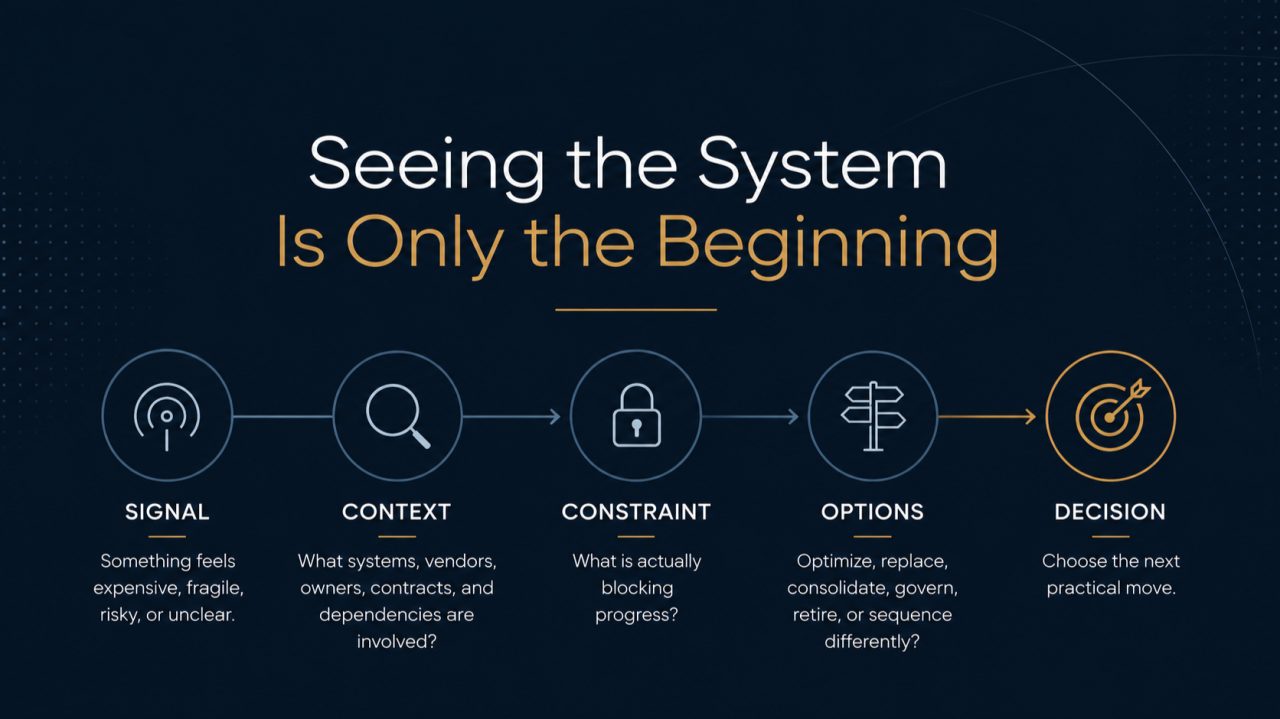
What most teams do next is predictable.
They evaluate replacement vendors.
They’re not actually preparing.
They’re performing preparation without understanding the problem. That distinction matters because the organizations that fail this transition won’t fail due to lack of effort. They’ll fail because their structure was never built to see what’s actually at risk.
The POTS sunset isn’t a procurement event.
It’s a diagnostic test.
The Signal
When I walk into an organization to assess their exposure, the first question I ask is simple:
Where are all your analog lines, and what do they support?
If the answer is slow, partial, or guessed, they’re already behind.
That hesitation reveals three structural problems immediately:
- No visibility into what exists
- No ownership of who’s responsible
- No strategy for what happens next
The language tells you everything:
- “I think we still have a few lines for alarms”
- “That might be handled by facilities”
- “Our vendor set that up years ago”
- “It’s bundled in our bill somewhere”
This isn’t a documentation issue.
It’s organizational blindness.
What’s Actually Happening Underneath
POTS lines weren’t deployed as a system. They were added over decades through IT decisions, facilities installs, security vendor requirements, and one-off fixes.
There was never a single point of control. So, there’s no single system of record.
Ownership is fragmented:
- Phone lines sit with IT
- Alarm circuits sit with security vendors
- Elevator lines sit with facilities
- Fax lines sit at the department level
Everyone owns a piece. No one owns the whole.
When you try to map dependencies, you’re stitching together partial truths from decisions made years ago that no one has revisited. The paper trail doesn’t match reality. Lines get repurposed. Vendors change configurations. Billing continues even after usage stops.
Even when organizations try to “just look at the bill,” it doesn’t translate into usable intelligence.
This isn’t a data problem.
It’s a coordination problem.
Why Your Carrier Isn’t Sounding the Alarm
Most organizations assume their carrier rep will flag this before it becomes urgent.
They won’t.
The incentives are misaligned. Reps are paid to retain revenue and close new business. They’re not paid to proactively eliminate legacy services.
POTS is still high-margin revenue. Low usage. High monthly cost. Minimal support. From a carrier perspective, there’s no urgency to push customers off unless forced.
There’s also a knowledge gap. Some reps understand the timeline and downstream impact. Many don’t go deep enough to connect it to alarms, elevators, or compliance systems.
So, what do you actually see?
- Gradual price increases
- “End of support” language buried in notices
- Limited availability for new installs
What you won’t see is a direct call telling you to move now.
You can’t outsource awareness to your carrier.
Your rep is a resource, not a strategist.
The Organizations Most at Risk
The risk profile is consistent:
- 20 to 250 employees
- Multiple locations
- Distributed decision-making
- Light or outsourced IT
- Separate vendors across telecom, security, and facilities
Small businesses are simple. Enterprises have structure.
Mid-market organizations sit in the worst position. Complexity has outgrown visibility, but governance hasn’t caught up.
That creates three forms of blindness:
- Operational. They can’t see what exists
- Ownership. They don’t know who’s responsible
- Risk. They don’t understand what fails
That’s exactly why decommissioning catches them off guard.
Why the First Response Makes It Worse
Once organizations realize there’s a problem, they move fast.
They go straight to the carrier and ask what replaces these lines.
That feels like progress.
It isn’t.
They skip discovery and jump to solutions. Without mapping what exists and what each line supports, they apply generic solutions to very specific problems.
The result:
- Overbuilt in low-risk areas
- Under-protected in critical systems
- Missed dependencies like alarms and elevators
They treat it like a telecom upgrade instead of a business risk.
That risk isn’t just operational.
It’s regulatory.
Many of these lines support systems tied to life safety and compliance. Fire alarms, elevator communications, and E911 requirements don’t tolerate failure or misconfiguration. If those dependencies aren’t identified upfront, the result isn’t just downtime. It’s failed inspections, liability exposure, and expensive rework under pressure.
That’s where the damage happens.
The Organizational Psychology Behind the Rush
This isn’t just structural. It’s behavioral.
Mid-market organizations are wired for speed. Leaders are used to solving problems quickly, so the instinct is to “just fix it.”
Slowing down feels like hesitation.
Discovery introduces ambiguity:
- “We don’t know how many lines we have”
- “We’re not sure what they support”
- “We need multiple teams involved”
That feels messy.
Buying a solution feels clean.
Internally, “we bought something” looks like progress. “We’re mapping and assessing” looks like delay.
So even when leaders know they should slow down, the organization pushes them forward.
What Competent Organizations Do Differently
The difference isn’t budget or intelligence.
It’s ownership.
Competent organizations have a clearly defined owner of infrastructure as a business function.
They can answer:
- What do we have
- What does it support
- What’s changing
- What’s our plan
They can also:
- Treat infrastructure as a lifecycle
- Maintain a usable source of truth
- Align IT, facilities, finance, and vendors intentionally
- Use vendors for options, not direction
That structure eliminates most of the chaos before it starts.
The Result
When organizations operate this way, decommissioning doesn’t trigger panic.
They already have:
- Visibility into where analog lines exist
- Awareness that legacy systems need review
- A process for evaluating change
Instead of reacting, they absorb the change into an existing system.
The Broader Lesson
The POTS sunset isn’t the problem.
It’s the forcing function.
It exposes whether an organization can:
- See its environment
- Coordinate across functions
- Manage infrastructure over time
Most organizations haven’t built that capability.
That’s why this transition feels harder than it should.
Closing Perspective
The question isn’t whether this will affect your organization.
AT&T alone is retiring copper services for approximately 90,000 customers across 18 states by November 2026. The timeline is compressing faster than most expect.
The real question is whether your organization has the structure to handle it without chaos, rework, and costly mistakes, especially when safety and compliance systems are involved.
If you can’t answer:
Where are all your analog lines, and what do they support?
You’re not behind on telecom.
You’re behind on visibility.
And visibility problems aren’t solved by moving faster.
They’re solved by building the ability to see what actually matters.
This issue also ran on LinkedIn, where you can follow Signals & Systems.