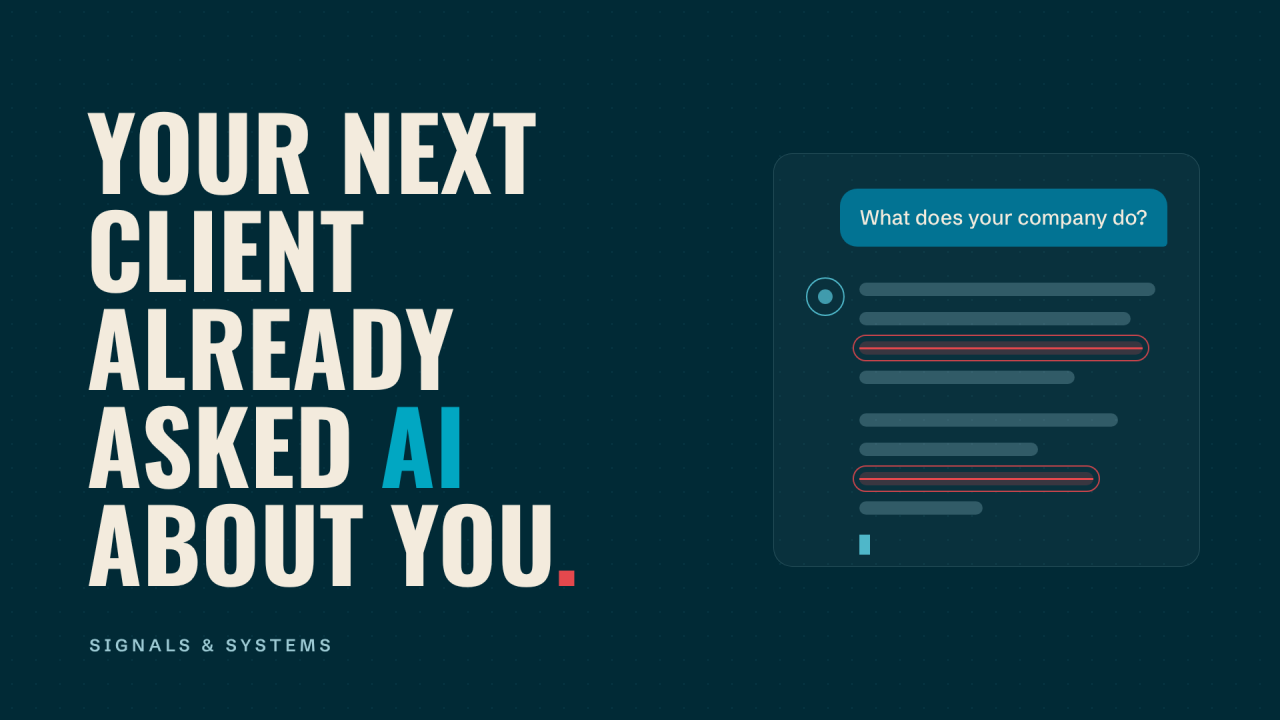
A prospect hears your name at a chamber breakfast. On the drive back, she asks her phone what your company does.
The answer takes four seconds. It's confident, it's tidy, and it describes a business you stopped being two years ago. Or it lists your competitor first. Or it says it isn't sure you exist.
You'll never see that answer. She won't mention it. She'll just call someone else, or she won't call anyone at all.
This issue is the third about the front door, and it's the one most companies haven't looked at yet. Your website is the door people walk through. AI is now the person standing outside it, telling them what's inside before they knock.
So this one is a method, not an argument. You don't need a developer to do it. You need an hour, a few AI assistants, and a notepad.
The Signal
Business buyers have moved their research into AI tools, and they did it quickly. Forrester's 2025 Buyers' Journey Survey found that 94 percent of B2B buyers used AI somewhere in a recent purchase. And twice as many buyers named generative AI their most meaningful source of information as named any other source. That put it ahead of vendor websites, product experts, and salespeople.
Gartner's numbers are more conservative, and still hard to ignore. In a survey of 645 B2B buyers, 45 percent said they used generative AI, mostly to gather information on vendors and products.
But buyers don't fully trust what they get back. In that same Gartner survey, 51 percent said they're more likely to run into misleading information from generative AI than from a sales rep.
Put those numbers side by side. Buyers are asking. The answers are often wrong. And the company being described usually has no idea what was said.
Insight worth remembering: AI doesn't update when you do. It keeps describing the company it last found.
How AI Builds an Answer About You: Five Things to Check
An AI assistant doesn't know your company. It pieces together an answer from whatever it can find and read: your site, your listings, and what other people have written about you. Most of that is in your control, or close to it.
1. Your homepage, in plain words
What it is: the first screen of your website, plus the page title that shows up in a browser tab and in search results. It's the first place an assistant looks to learn what you do.
Where to find it: open your homepage and read only what's visible before you scroll. Then look at the tab title.
What to do: make sure that first screen says, in words a stranger would use, what you do, who it's for, and where. "Innovative solutions for tomorrow" tells an assistant nothing. "Commercial HVAC service for property managers in Greater Boston" tells it everything.
2. Structured data
What it is: a small block of code behind your pages that labels the facts for machines. This is our business name. This is our address. These are our hours. These are our services. People never see it. Search engines and AI tools read it first.
Where to find it: paste your homepage address into Google's Rich Results Test or the Schema.org validator. If nothing comes back, nothing is labeled.
What to do: ask whoever manages your site to add Organization or LocalBusiness markup, with your legal name, address, phone, hours, and the services you actually sell. Most website platforms support it. It's usually an afternoon of work, not a project.
3. Your listings agree
What it is: your Google Business Profile, your LinkedIn company page, chamber and industry directories, and any review site that lists you.
Where to find it: search your company name and open the first ten results.
What to do: check that the name, address, phone number, and description match everywhere. An old suite number or a service you dropped in 2022 is enough to confuse an assistant. And when two sources disagree, it'll often pick the wrong one, or hedge and say nothing useful.
4. Other people's words
This is the part most companies miss. Assistants lean heavily on what others say about you: reviews, local press, partner pages, association listings, case studies on a client's site. Your own site makes the claim. Third parties make it believable.
So look at what exists outside your website. If your best work only appears on pages you wrote yourself, an assistant has very little to go on. A few detailed reviews that name the problem you solved will do more than another page of marketing copy.
5. Somebody checks the answer
The last one isn't technical. It's a person. Someone in your company should ask ChatGPT, Gemini, Claude, and Copilot the same questions a buyer would, a few times a year, and write down what comes back.
Try three prompts. What does our company do, and who is it for? Who are the best options for what we sell in our area? Is our company a good choice, and why? Then compare the answers to what's true. The gaps will point straight back to items 1 through 4.
The Website Is the Foundation
If you only fix one thing on this list, make it the website.
Of the five, the first two matter most, because the others build on them. Your directory listings, your LinkedIn page, even the way clients describe you, all tend to echo how you describe yourself. If that description is vague, everything downstream is vague too.
And the payoff goes well past what AI tells buyers. More of a company's own work runs through AI every month: drafting proposals, writing posts, answering a prospect's email, briefing a new hire. Point any of those tools at a site with clear messaging and correct schema, and it gets you right the first time. Point it at a vague one, and you'll spend the afternoon correcting it.
So it's worth slowing down on the words. That usually means the messaging, not a redesign, and it doesn't take an AI-visibility subscription either. The fundamentals do most of the work. What do you do? Who is it for? Why you and not the next firm? Get those answers right, label them properly, and everything built on top gets easier, whether a person or a machine is reading.
What This Looks Like in Practice
Earlier this month, I ran this test on my own firm. I asked ChatGPT, Gemini, Claude, and Copilot what The Deady Group does and whether it's any good.
The answers didn't match. Some models did better than others, but each one told a slightly different story, and a couple described the firm as it was in 2025, before we added growth advisory and the Digital Presence Review. Plenty had changed on our end. Nothing had changed on theirs.
Follow-up questions turned up more. But a buyer doesn't ask the follow-ups. They read the first answer and move on.
Still, I'd take an outdated answer over the alternative. Worse than being described wrong is not being seen at all, because an assistant that can't find enough about you usually just names someone else.
The test also showed where the good answers came from. The sources assistants seem to trust most aren't the ones a company writes about itself. They're the ones actual people keep current, like industry directories, chamber listings, market intelligence platforms, and publications with editors. Be in those. Be accurate there.
That's the point of checking. You can't fix an answer you've never read.
A Practical Lens
Before your next marketing push, it's worth being able to answer these:
- If a stranger read only the first screen of our homepage, could they say what we do and for whom?
- Does our site carry structured data, and does it match our current name, address, and services?
- Do our Google, LinkedIn, and directory listings all say the same thing?
- Where, outside our own website, does someone describe our work in detail?
- What do ChatGPT, Gemini, Claude, and Copilot say when asked about us today?
- Who in the company owns that answer?
You don't have to fix everything at once. Most of what you'll find is small. The goal is to know what's being said before a buyer hears it.
Where The Deady Group Fits
This is part of the Digital Presence and Technology Review we run for companies. One of its eight sections covers AI discoverability and structured data. It looks at what assistants can find, what they can't, and how your answer compares to the competitors your buyers are also asking about. For a limited time, we're running it at no charge.
The report puts every finding in order of what to fix first. We work with your web team or MSP, not around them. They usually know the site better than anyone. What's often missing is someone asking the question from the buyer's side.
If you'd like to see what AI says about your company, start a conversation.
Closing Thought
For twenty years, the question was whether people could find you. Now it's what they're told when they do.
Your company is already being described. The only question is who wrote the description.
P.S. Before you close this, ask an AI assistant what your company does. If the answer surprises you, forward this to whoever runs your website.
This issue also ran on LinkedIn, where you can follow Signals & Systems.