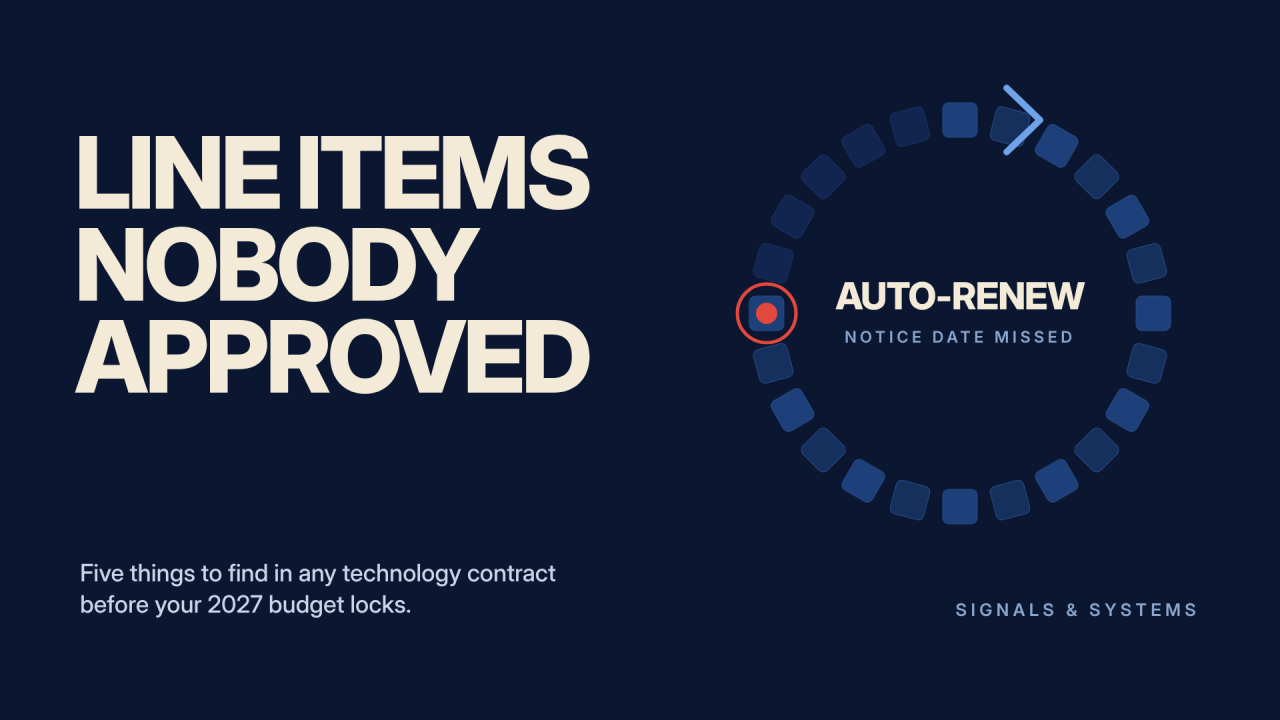
The renewal email arrives on a Tuesday. It's polite, and it's already too late.
The contract renewed last month. The price went up 9 percent. The window to cancel, or even to negotiate, closed 60 days before that. No one decided to keep the software. But no one decided not to, either. The contract treats those two things the same way.
That's happening in a lot of companies this month. October is when most leadership teams build next year's budget, and technology tends to get carried forward as last year's number plus a little. But that number isn't one decision. It's a stack of contracts, and each one has its own terms, its own dates, and its own way of growing.
So, this issue is a little different. It's less an argument and more a method: five things to find in any technology contract before the budget locks. You don't need a procurement team to do it. You need your ten largest contracts, an afternoon, and a highlighter.
The Signal
Price increases at renewal are now the normal case. In the 2026-27 Telarus Tech Trends Report, 87 percent of IT buyers said their renewal costs rose in the past year. The survey covered 503 midmarket and enterprise buyers and was run by an independent research firm.
And buyers aren't happy about it. In the same survey, 84 percent said they're open to switching vendors at renewal, and 29 percent regret a major technology purchase from the last two years.
But being open to switching only helps if you know the date. Most of that leverage sits in the weeks before a notice deadline, and it's gone once the deadline passes.
Meanwhile, a good share of what renews every year isn't being used. In its 2026 IT expense management trends report, Tangoe, a technology expense management firm, says nearly half of paid SaaS licenses went unused in 2025. The report draws on the $34 billion in technology spend Tangoe tracks. At smaller companies, the pattern looks the same, just with fewer zeros.
Insight worth remembering: a budget is a list of decisions. A renewal is a decision that gets made for you if nobody makes it first.
How to Read a Renewal: Five Things to Find
Most technology contracts are long, but the parts that drive next year's cost are short. There are five of them. Once you know what they're called, they're easy to spot.
1. The notice window
What it is: the deadline to tell the vendor you're not renewing, or that you want different terms. It's almost never the renewal date. It's usually 30, 60, or 90 days before it.
Where to find it: search the contract for "renewal," "auto-renew," "evergreen," or "non-renewal." It's often a single sentence in the Term section.
What to do: put the notice date on a calendar, not the renewal date. If a contract renews March 1 with 90 days' notice, the decision is due around December 1. That's this quarter.
2. The uplift clause
What it is: the language that says how much the price can rise at renewal without a new agreement. Some contracts cap it. Others say "then-current list price," which means there's no cap at all.
Where to find it: look for "price increase," "uplift," "CPI," or "then-current."
What to do: if there's no cap, ask for one before you sign the next term. A ceiling tied to inflation or a fixed percentage turns an open question into a known worst case. And if a vendor won't agree to any cap, that tells you something too.
3. The unit
What it is: the thing you're billed on. A user, a contact, a device, a location, a message. This one's easy to miss, because the price per unit can stay flat while the bill climbs. All it takes is a change in how the unit is counted.
Where to find it: the order form and the definitions section. Compare the definition in your signed contract with the one on the vendor's pricing page today.
What to do: count your units the way the vendor counts them. Then ask who in your company can add more without anyone approving it.
4. The bundle
This is when features get added to the plan you're already on and the price moves to match. AI is the common example this year. In July, Microsoft raised list prices on most commercial Microsoft 365 plans and pointed to the AI, security, and management features it had added to them. You pay for those whether your team uses them or not.
You'll see it in the renewal quote as a changed plan name, a tier that no longer exists, or new line items inside the same total. So ask what was added, who's using it, and whether a plan without it is still offered. Sometimes the answer is no. But it's better to learn that before the quote is the only option left.
5. The owner
The last one isn't in the contract. It's the person inside your company who can answer three questions. Who signed this? Who uses it? Who'd notice if it went away?
Write one name next to every contract. If you can't, you've found the contracts most likely to renew on their own. And without an owner, nobody reads for the other four.
What This Looks Like in Practice
Consider a 60-person distributor. This is an illustration, not a client, but the shape will be familiar.
The controller builds the 2027 budget from this year's actuals and adds 5 percent for technology. Then three things show up that the 5 percent didn't cover.
The phone system renewed in September for another three years. The notice window was 90 days, so the decision was due in June.
The CRM is billed per contact, and sales imported a trade show list in the spring. The price per tier didn't change, but the company is now two tiers higher.
And the office productivity suite went up at renewal because the plan now includes AI features. A handful of people have tried them.
Each of these made sense to the person closest to it. But no one was looking at all three, and the 5 percent was gone before January.
A Practical Lens
Before the 2027 budget is final, it's worth being able to answer these:
- Which of our technology contracts renew in the next six months, and what's the notice date on each?
- Which ones can raise the price at renewal without our agreement, and by how much?
- What is each one billed on, and has that count grown since we signed?
- Did any plan change its name, its tier, or its included features this year?
- Is there one name next to every contract?
- Is anything we run reaching end of support next year?
That last one isn't a renewal, but it lands in the same budget. For example, Microsoft ends extended support for Windows Server 2016 on January 12, 2027. If a server in your building still runs it, that's a 2027 line item whether it's in the spreadsheet or not.
You don't have to act on every answer. Plenty of renewals are fine as they are. The goal is to make them decisions.
Where The Deady Group Fits
This is the kind of review we do with clients. We read the contracts and the bills together, put the notice dates on one calendar, and mark which renewals are worth a conversation and which are fine as they stand.
There's no upfront fee for that analysis. If it leads to a change of provider, the provider compensates us, and we disclose that before you decide anything. We also put staying where you are on the table every time, whether that means renewing on better terms or buying nothing at all. That's written into our Client-First Transparency Standard.
And we work alongside your IT team or MSP, not around them. They usually know the systems better than anyone. What's often missing is the afternoon to read the paper.
If you'd like a second set of eyes before your budget locks, start a conversation.
Closing Thought
Most technology budgets don't get blown by a bad decision. They drift, one unread renewal at a time.
So read the renewal before it reads you.
P.S. If this was useful, forward it to whoever approves your software invoices. If you're not sure who that is, that's your first finding.
This issue also ran on LinkedIn, where you can follow Signals & Systems.