Your clients trust you with their technology. We help you grow what that trust is worth.
Most MSPs do not have a growth problem. They have a reason-to-call problem: the relationship is strong, the renewal is safe, and there is nothing new to say until something breaks. The Deady Group gives you something to say. A Digital Presence & Technology Review, delivered under your relationship, that opens a strategic conversation with every client and prospect you name. What the Review surfaces, our growth bench carries. The technical relationship stays yours.

The problem, plainly.
"MSP marketing" is a crowded phrase, and most of what it sells is content: posts, newsletters, a refreshed site. Useful, and rarely the constraint.
The constraint is that a managed service relationship is built to be quiet. It works when nothing happens. That is good operations and poor conditions for growth, because growth needs a reason for the client to think about their technology strategically, and a reason for a prospect to take the meeting.
Vendor co-marketing offers a reason, but it is the vendor's reason. A marketing agency offers volume, but not a diagnosis. What an MSP needs is an independent, credible reason to talk that is about the client's business, and a partner who can do the growth work that follows without competing for the technical seat.
How the partnership works.
- You name the client or prospectOne at a time, or a list.
- We run the ReviewEight areas, scored against public standards, dated, in plain language. Delivered within three business days, under your relationship.
- You present it, or we present it togetherThe findings are the client's; the conversation is yours. We stay in the room if you want us there and out of it if you don't.
- The work divides cleanlyTechnical findings go to you. Growth and go-to-market findings (positioning, search, demand, revenue systems) go to our growth bench, under our direction and accountability. Anything outside both goes to a specialist we vet and introduce.
- Compensation is disclosed in both directionsWho pays whom, for what, in writing, before the first Review is delivered. The same standard we hold with every client.
What you keep, what we carry.
| You keep | We carry |
|---|---|
| The technical relationship and the operations | The diagnosis and the strategic conversation it opens |
| The infrastructure, security, and support work the Review surfaces | The growth and go-to-market work the Review surfaces |
| Your name on the relationship | Accountability for what our bench delivers |
| The client | The reason to call |
We do not pursue the technical seat. Where what we can arrange overlaps with what you sell, and occasionally it does, we say so before it matters and work to keep the situation from arising at all. The commitment is transparency, not maneuvering around you.
Why this, and not the usual options.
| Option | What it is paid for | What that produces |
|---|---|---|
| An MSP marketing agency | Content volume | Activity, and a hard time proving it moved anything |
| Vendor co-marketing | The vendor's product | A reason to call that is really the vendor's reason |
| Hiring a marketer | Salary | One person carrying a function, without a diagnostic to lead with |
| The Deady Group | Disclosed, per engagement | A diagnostic your client wants, a strategic conversation you lead, and a growth bench that does the work while you keep the seat |
Evidence.
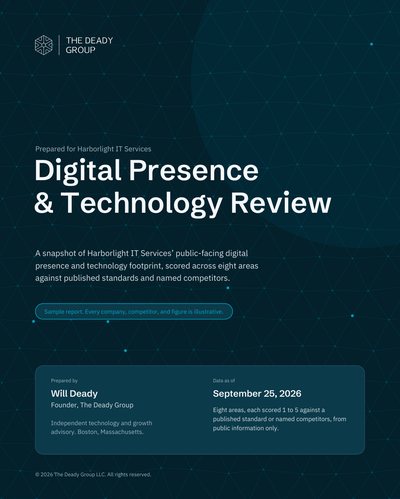
Read a complete Review, redacted.
As a client would receive it.
Open the sampleFrom services revenue to a repeatable software business.
A telecom infrastructure software company with a product its customers wanted and a consulting firm's books underneath it. The growth bench rebuilt the financial model around recurring revenue and retention, then built the go-to-market engine on top: quota modeling, cost allocation, sales compensation, a bottom-up growth model, and the case to the board.
The company now runs as the software business it had become.
Read the caseWill Deady spent ten years in enterprise technology sales, advisory, and operations, including at 451 Research within S&P Global, where he sold research, analyst access, and go-to-market work to technology companies. He founded The Deady Group in 2025 so that the advice and the sale would come from different places, and so that the compensation behind a recommendation would be disclosed rather than assumed.
Bring one client.
The fastest way to evaluate the partnership is to run one Review for one client you would like to have a strategic conversation with. Three business days later you have the report, the conversation, and a clear read on whether this is worth doing at scale.
Do you compete with us for the technical work?
We do not pursue the technical seat. Technical findings from the Review go to you; we carry growth and go-to-market work and route anything outside both to a specialist we introduce. There is occasional overlap between what we can arrange and what you sell. When it exists, we tell you before it matters and do our best to avoid it entirely.
How are you compensated?
It depends on the engagement, and it is always disclosed in writing before we start: sometimes the client, sometimes a provider the client selects, sometimes an arrangement with you. You will never learn how we are paid after the fact.
What does the client see?
An eight-area, 21-page Review with findings in plain language and a recommended path. We prefer to deliver it co-branded or under The Deady Group's name, since an independent name on the method is part of what makes it credible to your client. If your relationship calls for it, it can carry your brand alone. Your name is on the conversation either way.
A reason to call, and a bench to follow it.
The Digital Presence & Technology Review is the fastest way to see how we work, and it costs nothing. If the situation is already clear, start a conversation instead.