Modernization rarely fails loudly.
It slows.
Roadmaps stretch. Dependencies multiply. Risk reviews expand. Teams spend more time coordinating than delivering.
From the outside, it looks like hesitation. From the inside, it feels like drag.
Most leaders treat that drag as a resourcing problem. Not enough people, budget, or time.
More often, it’s something else.
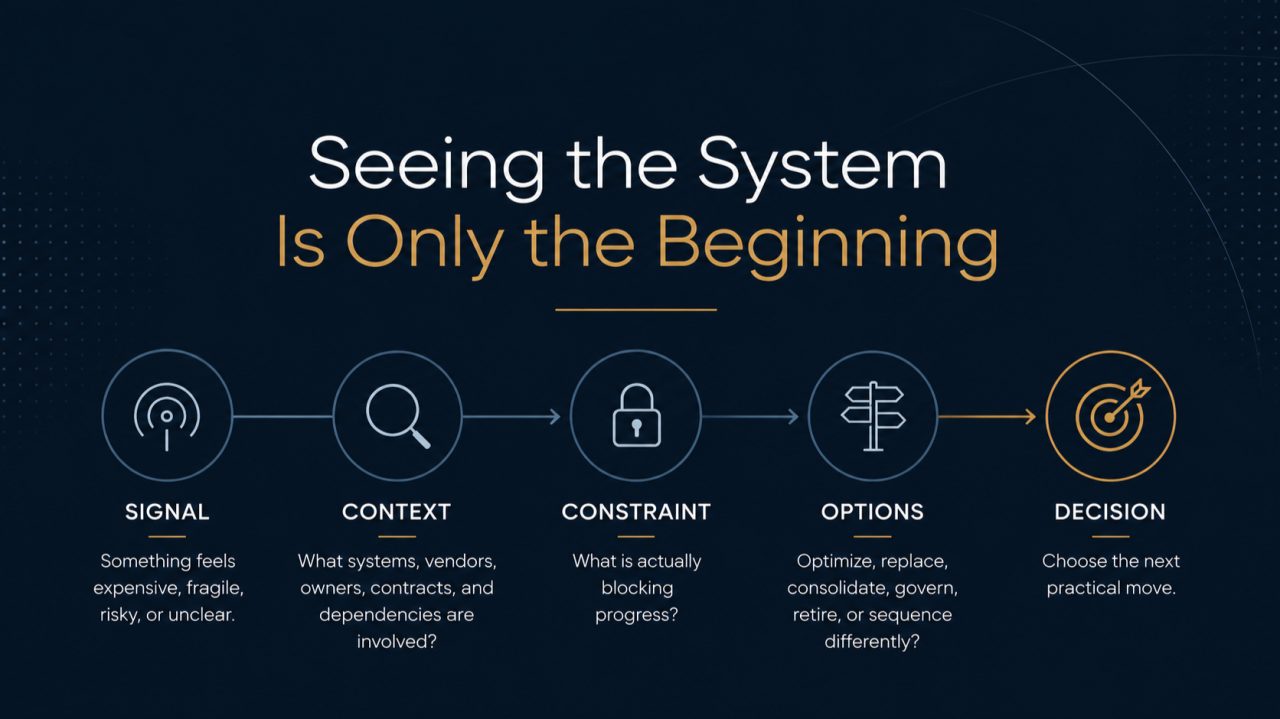
The Signal
When delivery effort starts turning into coordination instead of progress, the environment is constrained.
That shift is subtle. It shows up in the middle of transformation, right when momentum is supposed to increase.
What’s Actually Happening
As organizations modernize, they increase interdependence faster than they reduce complexity.
Each new platform promises efficiency. Each integration promises leverage. Each governance layer promises control.
Individually, those decisions make sense.
Collectively, they create a system with more interaction points, more handoffs, and more ways for change to get expensive.
That’s why modernization often feels harder at the midpoint than it did at the start.
How This Shows Up in Real Environments
You can usually see it in a few familiar patterns:
- Initiatives require more stakeholders than expected
- Risk assessments expand instead of shrinking
- “Quick wins” quietly disappear from the roadmap
- Teams default to caution because every change feels costly
None of this means the strategy is wrong.
It means the system is saturated.
The Move That Adds Drag
When progress slows, leaders often respond by adding.
Another platform. Another governance layer. Another initiative.
Each response increases load on the same constrained system.
The result is more motion and less momentum.
A More Useful Reframe
Momentum comes back when leaders reduce interaction cost before adding new capability.
That means simplifying integration paths, clarifying ownership, retiring systems that consume attention disproportionate to value, and reducing decision latency across security, compliance, and operations.
This isn’t about slowing innovation. It’s about making progress cheaper again.
A Practical Lens
Instead of asking, “What should we build next?” ask this first:
Where does change cost us the most energy today?
That answer almost always reveals the real constraint.
Closing Thought
Modernization doesn’t stall because organizations lack ambition.
It stalls when systems demand more coordination than the organization can sustainably supply.
Leaders who see that clearly regain leverage. They sequence better, reduce friction before adding force, and progress starts to feel possible again.
Clarity isn’t a mood. It’s a method.
For more context and field perspectives on modernization, resilience, and operational clarity, see Insights.
This issue also ran on LinkedIn, where you can follow Signals & Systems.