There's a growing consensus that organizations have too many tools.
Everyone seems to agree on the problem. Far fewer agree on what to do about it.
That disconnect is a clear signal.
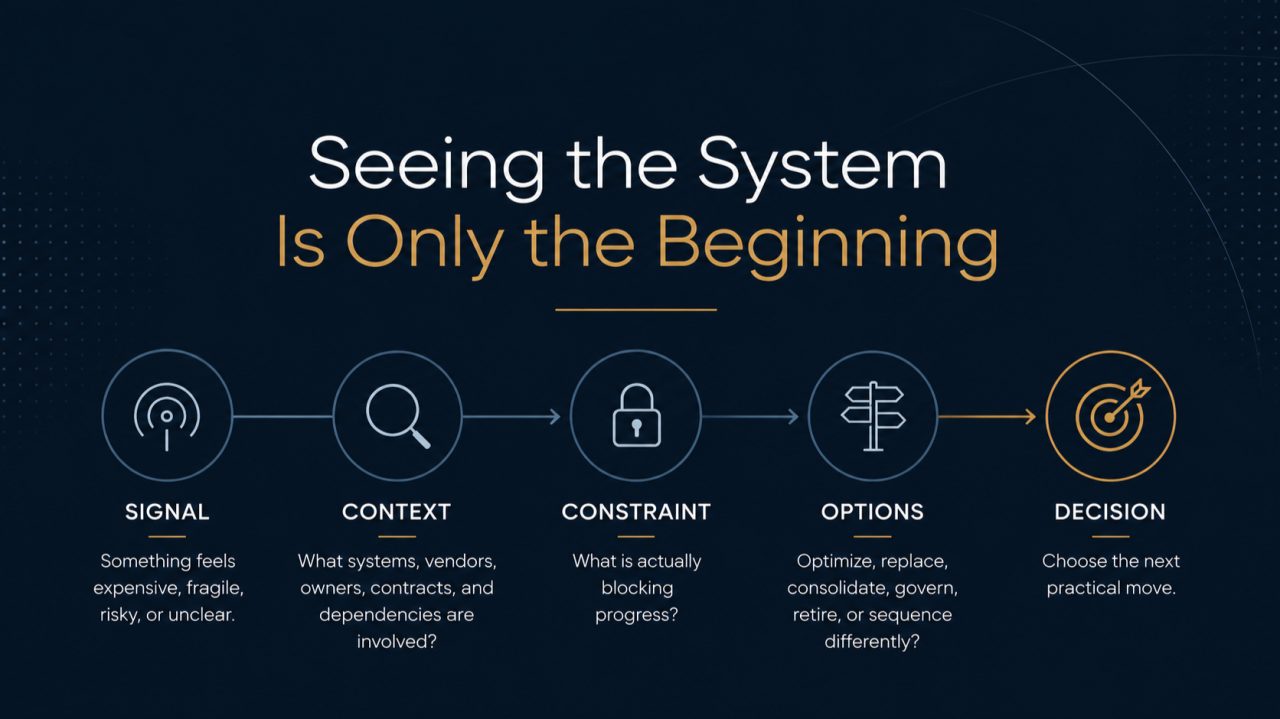
The Signal
At a recent industry event, I spoke with an IT leader at a regulated organization. When the topic of tool consolidation came up, he laughed. Not because it was funny. Because it was familiar.
Consolidation, in his world, isn't a clean initiative or a tidy roadmap. It's manual, slow, and surprisingly human.
It starts with conversations. Talking to stakeholders across the business to understand why a tool was brought in, what problem it solved at the time, who actually uses it, and whether it is still necessary.
Often, the answers are incomplete.
Some tools overlap heavily. Others duplicate functionality in subtle ways. In many cases, users rely on only a fraction of what a product can do. The real question becomes less about whether a tool is best in class and more about whether the organization truly needs one hundred percent of its capabilities, or if eighty percent coverage would be enough.
Layer in governance requirements, regulatory constraints, security controls, and brittle data integrations, and IT tool consolidation becomes something else entirely.
This isn't tool sprawl as a purchasing problem. It's tool sprawl as an operational reality.
What Is Actually Happening Underneath
Most organizations did not design their technology environment. They accumulated it.
Each tool made sense in isolation. Each decision was rational when it was made. A team needed to move faster. A risk needed to be reduced. A gap needed to be closed.
Over time, those decisions compound.
What emerges is not chaos, but opacity.
Systems of record and systems of action drift apart. Ownership becomes unclear. Data flows harden in unexpected ways. Dependencies exist, but they're rarely documented. In regulated environments, this creates audit risk, operational fragility, and security blind spots that no dashboard can fully surface.
Vendor sprawl is not excess. It's accumulated intent without a governing model.
That distinction matters.
What Breaks When This Is Misread
When organizations treat vendor sprawl as a simple numbers problem, the response is usually consolidation for its own sake.
Tools are removed without fully understanding what they touched. Capabilities are centralized, but context is lost. Local flexibility gives way to global rigidity.
On paper, the stack looks simpler. In practice, it becomes more brittle.
Resilience does not come from having fewer components. It comes from understanding how components interact.
Without that understanding, consolidation trades visible complexity for hidden risk.
The Reframe
The healthiest technology environments are not the ones with the fewest vendors.
They are the ones where interactions are understood.
Every tool sits in a web of dependencies. Data flows, access controls, workflows, integrations, and reporting obligations all connect in ways that are rarely obvious from a contract or a feature list.
When leaders focus only on reducing tool count, they often remove components without fully seeing what those components support. The visible stack gets smaller. The unseen risk grows.
The real objective is not simplification for its own sake.
It is predictability.
When teams understand how systems interact, consolidation becomes deliberate instead of disruptive. Change becomes safer. Surprises become rarer.
A Practical Lens
Instead of asking whether a tool is redundant, a more useful question is this.
If this tool disappeared tomorrow, do we know what would fail quietly?
Which workflows would degrade. Which reports would stop reconciling. Which controls would raise flags weeks later, rather than immediately.
Who would notice first? A user. An auditor. A customer. Or no one at all.
If the answer is unclear, that uncertainty becomes the risk.
This lens doesn't produce instant answers. It produces predictability. And predictability is what allows consolidation, modernization, and change to happen without unintended consequences.
It produces clarity.
If this way of thinking reflects challenges you are navigating, I am always open to a conversation.
This issue also ran on LinkedIn, where you can follow Signals & Systems.