Most technology environments don’t fail because the tools are bad.
They fail because the system between the tools isn’t fully understood.
The most common breakdowns aren’t always dramatic outages or headline incidents. More often, they begin quietly. They show up as delayed decisions, messy escalations, duplicated effort, and progress that feels expensive even when the strategy itself is sound.
That’s usually a seam problem.
A seam is the space where responsibility shifts. Between teams, vendors, internal ownership and external delivery.
The tools may be solid. The architecture may be modern.
But the seams are where systems fray.
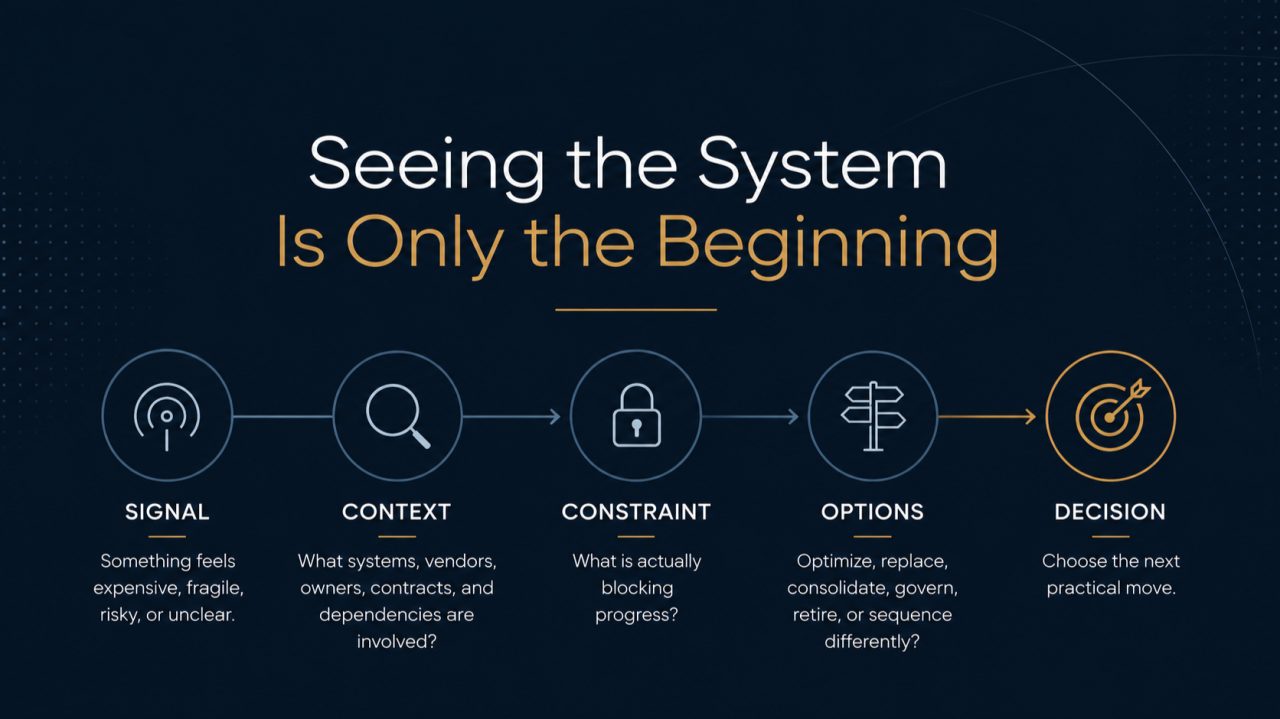
The Signal
When accountability is fragmented, preventable gaps appear.
Everything can look fine on paper.
The vendor is in place. The partner ecosystem is strong. The platform is best in class.
And still, execution slows.
Not because anyone is failing, but because responsibility is distributed in ways that don’t match how work actually happens day to day.
The system is operating. But it's harder to operate.
That distinction matters.
What This Looks Like in the Field
A familiar pattern shows up in multi-vendor environments.
A service degrades after hours. Voice quality drops. Users begin reporting failures. The issue is real, but the ownership path is not.
Internal IT assumes the service provider owns first response. The provider assumes the carrier owns escalation. Security is looped in because compliance might be impacted. Operations just needs the phones working by morning.
No one is negligent.
No one is acting in bad faith.
But the seam lives in the handoff.
And that is how small incidents become coordination storms.
Why Seams Fail Quietly
Modern technology environments are multi actor systems.
Internal IT ↔ Security ↔ Operations ↔ External partners ↔ Vendors ↔ Compliance
Each actor behaves rationally inside their lane. Each decision makes sense locally.
The risk appears globally.
And often, seams persist not because people are unaware, but because accountability crosses budget lines, contract boundaries, or organizational walls.
As environments grow, interdependence increases faster than shared understanding. Integration points multiply. Governance expands. More people need to be involved simply to preserve safety.
That’s how coordination becomes the hidden tax.
It isn’t the tools that create fragility.
It’s the interactions between them.
The Seam Types That Create the Most Drag
Most operational friction shows up in three predictable places.
Ownership seams
A system has users, spend, and risk, but no single accountable owner. Shared ownership often means owned by no one in practice.
Workflow seams
Work crosses systems and teams, but handoffs aren’t explicit. Tickets bounce. Context gets lost. Resolution stretches.
Escalation seams
Something breaks at 2 am. Everyone is involved, but no one owns first response, communications, and final accountability.
These seams don’t just create inconvenience.
They distort decision making. Leaders respond by adding controls, expanding reviews, and slowing change because the system becomes harder to trust.
The Advisor’s Real Value
A trusted advisor doesn’t just introduce solutions.
They make systems legible.
That is the value I aim to bring in any environment I’m supporting. Seeing the seams, making them explicit, and reducing the operational cost of change before problems become urgent.
- This isn’t about catching mistakes. It’s about preventing predictable failure modes.
- Most operational drag isn’t inevitable. It’s structural. Structure can be clarified.
A Practical Method
Here’s a simple way to make seams visible without turning this into a six-month program.
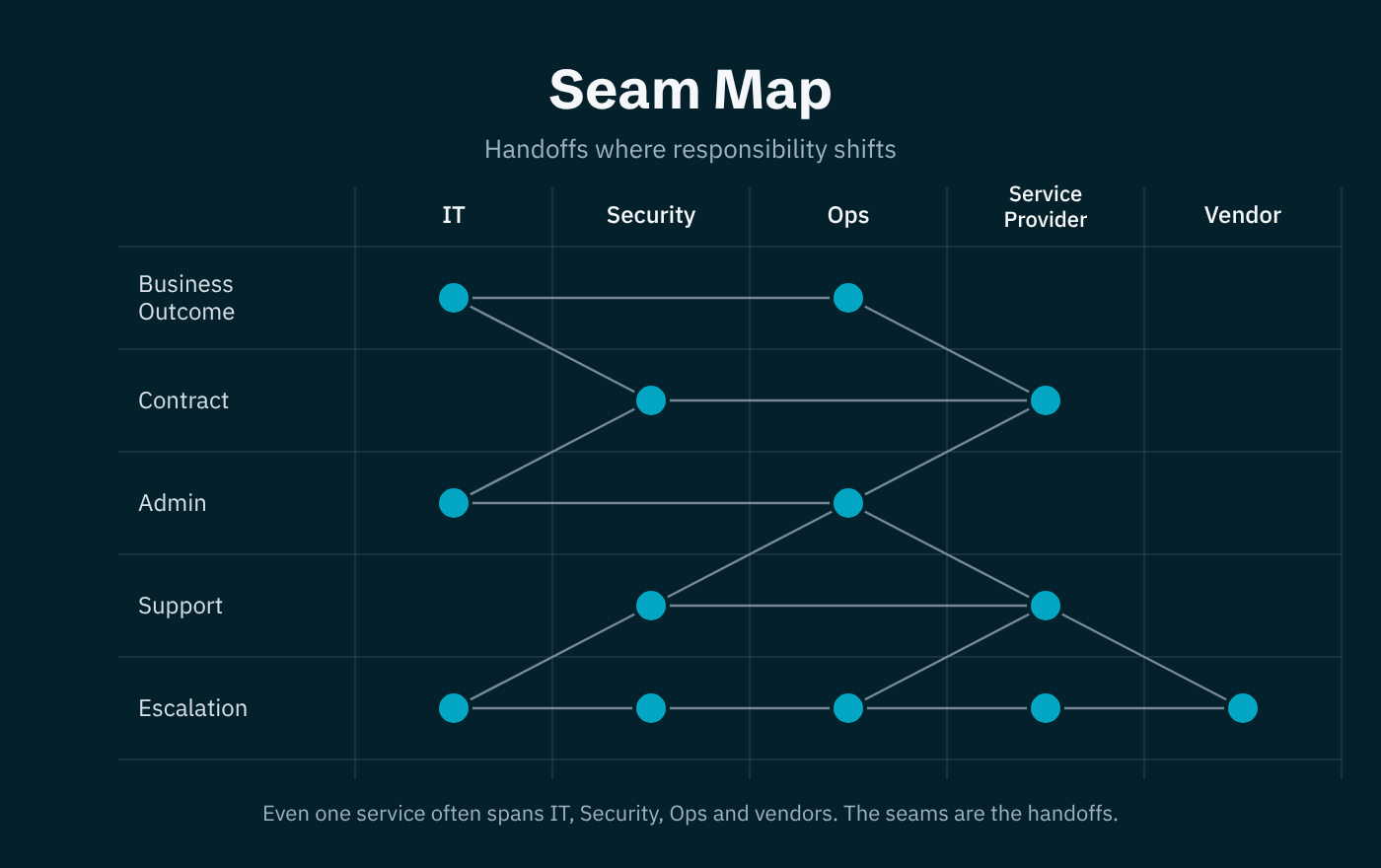
Step 1: Build a seam map for one critical service
Pick one service that can’t fail quietly: voice, identity, core networking, security monitoring, backup, remote access.
Write down, in plain language:
- Who owns the service outcome
- Who owns the contract and renewals
- Who administers the platform
- Who owns day to day support
- Who owns incident response and escalation
If those roles are scattered, that’s not inherently wrong.
It just needs to be explicit.
Step 2: Name the handoffs
Where does responsibility move from one party to another?
How does that handoff happen. Ticket, Slack, email, phone, portal?
If you can’t answer quickly, the seam is already costing you.
Step 3: Define the 2 am rule
If something breaks at 2 am, who owns first response, triage authority, internal communications, vendor escalation, and final accountability?
If the answer is “it depends,” the seam is real.
Closing Thought
Best in class technology matters.
But the outcomes leaders care about. Resilience, speed, clarity, trust. Are determined by how well the system is understood between the components.
Systems rarely break in the tools.
They break in the seams.
Key takeaway: the highest leverage work isn’t always choosing better tools. It’s making the seams between them visible, owned, and predictable.
For more field perspectives on resilience, operational clarity, and systems thinking, see Insights.
This issue also ran on LinkedIn, where you can follow Signals & Systems.