The Signal
Two of the most foundational vendors in enterprise IT have changed how they make money.
Not incrementally. Structurally.
VMware eliminated perpetual licenses. Everything is now subscription. Additionally, they've bundled products together in ways that force customers to buy more than they actually need.
Microsoft increased pricing in July 2025. However, the bigger shift wasn’t just price. It was how they go to market. Organizations under 25,000 users are now being pushed toward CSP models instead of direct relationships.
On their own, each change was manageable.
Together, they created something different.
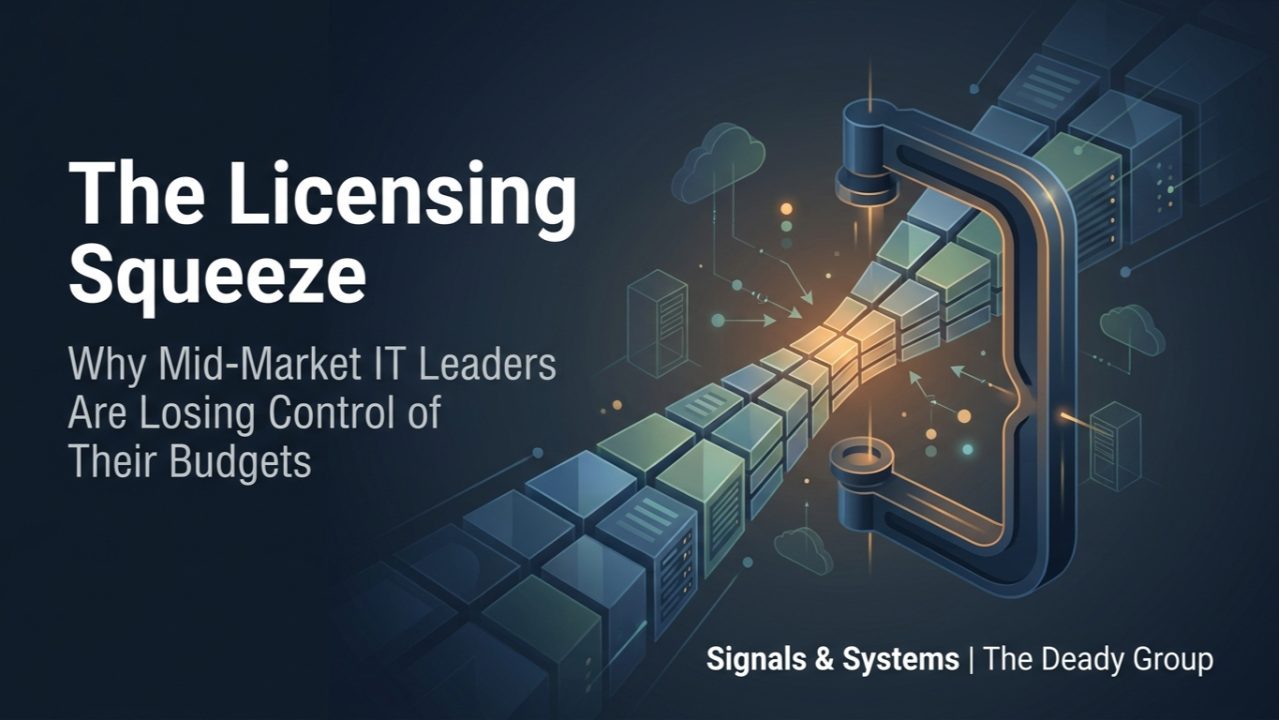
A squeeze.
In 2024, this felt like vendor noise. In 2025, it became real. In 2026, it’s hitting the budget.
What’s Actually Happening
Start with VMware.
Over the past 18 months, VMware’s shift under Broadcom has moved from announcement to reality.
You don’t own anything anymore. You subscribe. You don’t buy what you need. You buy what’s bundled. You don’t control timing. Renewals control you.
Additionally, if you miss your renewal date, you’re looking at a 20% penalty with no grace period.
However, the most disruptive change hasn’t been licensing.
It’s the partner ecosystem.
Broadcom moved VMware to an invite-only partner model, reducing thousands of providers down to a small set of strategic partners. Many organizations are now discovering that the provider they relied on for years is no longer authorized to support them.
That creates a very real problem.
Who supports your environment now? Who helps you renew? Who helps you migrate if you need to?
For many mid-market organizations, those answers aren’t clear.
Because the partner you trusted wasn’t just a reseller. They were the layer that helped you navigate complexity. Interpret licensing. Push back on vendors. Buy you time.
Now that layer is gone or significantly reduced.
Now look at Microsoft.
The July 2025 pricing increases are now working their way through renewals, and most organizations are starting to feel the real impact in their 2026 budgets.
E5 at $60 per user adds up quickly. A 3,000-person organization is looking at $180,000 a month before layering anything else in.
However, pricing isn’t the real shift.
The real shift is control.
Microsoft has moved smaller and mid-sized organizations toward CSP relationships. That changes how support works. It changes how pricing works. It changes who you talk to when something breaks or needs to be renegotiated.
Additionally, it introduces another layer between you and the vendor.
Which means less direct leverage.
The Pattern
If you step back, the pattern becomes clear.
Both vendors are doing the same thing in different ways.
- Moving to subscription-only models
- Bundling products to increase average spend
- Pushing multi-year commitments
- Tightening renewal enforcement
- Reducing flexibility
- Shifting support models
This isn’t random.
It’s optimization.
However, it’s not optimization for you.
It’s optimization for them.
What’s changed in 2026 is this:
These aren’t announcements anymore.
They’re showing up in renewal quotes, budget reviews, and uncomfortable conversations between IT and finance.
The insight worth remembering: When your vendor shifts from earning your business to monetizing your dependency, the relationship has fundamentally changed.
The Timing Problem Most Organizations Are Missing
This isn’t just a pricing problem.
It’s a timing problem.
Most organizations assume they can wait until renewal to figure this out.
That’s where things break.
Migration timelines are measured in months, not weeks. Provider capacity isn’t unlimited. And demand surges as deadlines approach.
We’ve already seen this pattern play out.
Organizations wait. Renewal hits. Options narrow. Costs go up.
Additionally, as more companies are forced to evaluate alternatives or migrate to new environments, the providers who can actually execute those migrations get booked out.
That creates a second layer of pressure.
Even if you decide to move, you may not be able to move fast enough.
The insight worth remembering: The risk isn’t just paying more. It’s losing the ability to choose when and how you respond.
Why Mid-Market Gets Hit Hardest
Large enterprises have already adjusted.
They have leverage. They have procurement teams. They have relationships inside the vendors. They can negotiate exceptions.
Mid-market organizations don’t.
Instead, they sit in the middle.
Too complex to ignore the changes. Too small to influence them.
Additionally, they often don’t have full visibility into their own environments. That makes it even harder to respond effectively.
Here’s how that plays out in 2026:
- You’re being pushed into bundles that don’t match your actual needs
- You’re navigating licensing changes without the partners you used to rely on
- You’re reacting to renewal timelines instead of planning ahead
- You’re making decisions without clear cost modeling
It’s not one big decision that creates the problem.
It’s a series of small ones made under pressure.
The Visibility Gap
This is where most organizations lose control.
Not at renewal.
Before it.
Most teams still don’t have clear answers to basic questions:
- How many cores are we actually licensing in VMware?
- How much of our Microsoft licensing is actually being used?
- When do our renewals hit, and what’s the real impact?
- What would alternatives actually cost over 3–5 years?
Without that visibility, you’re not making decisions.
You’re reacting.
Additionally, vendors know this. The less clarity you have, the easier it is to move you into a new model without resistance.
The insight worth remembering: You can’t control cost if you don’t understand what’s driving it.
A Practical Lens
If you're navigating this in 2026, here's where to focus.
Get visibility. Before you negotiate anything, understand your current state. Core counts. License usage. Renewal timelines. Without that, you’re guessing.
Evaluate alternatives early. Not because you need to move today. But because you need leverage.
Migration timelines are often 6–12 months. Additionally, as more organizations are forced into this decision at the same time, provider capacity becomes a constraint.
If you wait until renewal pressure hits, you’re not just choosing under pressure. You’re competing for execution.
Consider bridge strategies. If you're within 6–12 months of a renewal, you're already in the window where these decisions matter. Short-term strategies can buy time and prevent being forced into long-term commitments.
Don’t wait for renewal pressure. By the time the quote is in front of you, your options are already limited.
Involve finance early. This isn’t just an IT problem. It’s a cost structure problem. Modeling this over 3–5 years often changes the conversation entirely.
The Conversation That Needs to Happen
Most organizations are still treating this like a renewal discussion.
It’s not.
It’s a strategy discussion.
If you're in IT leadership, the conversation should sound like this:
"Our core vendors have already changed how they price and package their products. That’s going to materially impact our cost structure and flexibility over the next few years. Here’s what that looks like, and here are the options we should be evaluating now."
That shifts you from reactive to proactive.
Additionally, it brings finance into the conversation before it becomes a problem.
You Don’t Have to Navigate This Alone
This is where things get complex.
Licensing changes now intersect with infrastructure, cloud strategy, security, and compliance. Most mid-market organizations don’t have the time or internal resources to evaluate every path properly.
That’s where having the right partner matters.
Not someone pushing a product. Someone helping you understand your options, sequence decisions, and avoid getting boxed into a path you didn’t choose.
At The Deady Group, this is exactly where we spend time. Helping organizations understand where they stand, what’s changed, and what to do next.
If you're facing VMware or Microsoft changes in the next 12 months, it’s worth having that conversation early.
Closing Thought
The vendors haven’t changed who they are.
They’ve changed how they make money.
And in 2026, that shift is no longer theoretical. It’s showing up in your budget.
The organizations navigating this well right now aren’t the ones reacting fastest.
They’re the ones who moved early enough to keep their options open.
Because in this environment, timing is leverage.
The squeeze is real.
However, the bigger risk isn’t cost.
It’s losing control of when and how you respond.
The question isn’t whether the rules have changed. They have. The question is whether you’re moving early enough to stay ahead of them.
If you're working through these changes and want a sounding board before your next renewal cycle, I’m always open to start a conversation.
This issue also ran on LinkedIn, where you can follow Signals & Systems.