When I launched The Deady Group, I expected email setup to be simple. Buy the domain. Connect the inbox. Start communicating.
The reality was different. It took months to stabilize something I assumed would work by default. After running twenty mailboxes across multiple domains and rebuilding my DNS from the ground up, I learned a lesson most teams discover the hard way.
Deliverability has little to do with the tool you use to send a message. It has everything to do with whether the infrastructure beneath your domain earns trust from the systems that receive it. If that foundation is weak, even your best work lands in the wrong place.
This is where most organizations unknowingly create risk.
The data makes it clear:
- 70% of domains have SPF errors
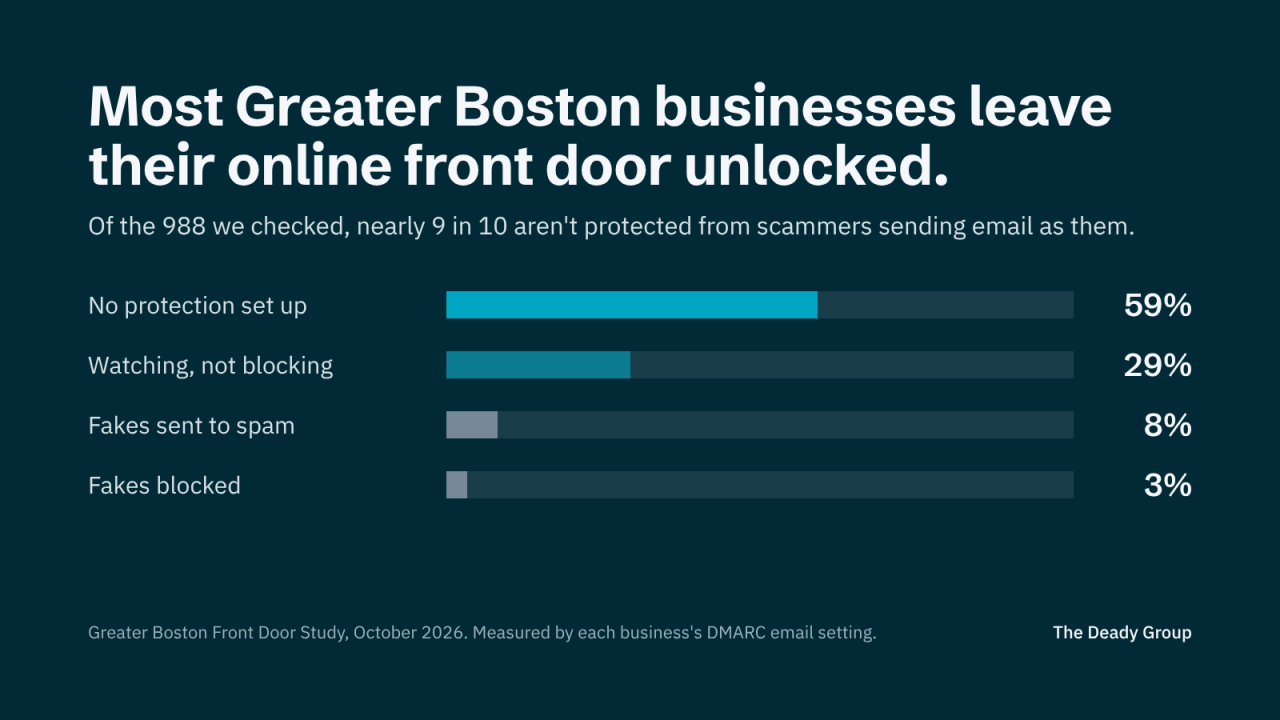
- 25% publish no DMARC record
- Among domains that do publish DMARC, 65% still use p=none, which monitors activity but offers no real protection against spoofing
- Fewer than 10% qualify for BIMI. BIMI acts as a trust badge that signals authenticity in the inbox.
Here's the real issue. A domain running DMARC in p=none is fully vulnerable to spoofing. Mailbox providers can report the failures, but they will not block impersonation. That exposes your customers, employees, and partners to messages that look legitimate but are not. It also erodes domain reputation every time a fraudulent message slips through.
A message can be delivered and still fail. Landing in spam is not a technicality. It is a lost opportunity. Enough failures and your reputation weakens, which affects every future message you send.
This is where modernization and AI readiness intersect. Many organizations want automation, efficiency, and scale. But if the underlying infrastructure is not trusted, automation becomes noise. You end up pushing more messages into an ecosystem that does not believe you.
Experts often say companies are not AI ready because of their underlying data. Email authentication is part of that same equation. If the base layer is not clean, consistent, aligned, and enforced, the technology on top of it will not perform.
I learned that firsthand. I tightened SPF. Ensured DKIM alignment. Configured DMARC correctly. Removed DNS clutter that created silent friction. Once the foundation was solid, everything else improved. Deliverability increased. Messaging stabilized. The entire system worked the way it should.
If you're building or optimizing your organization, look beyond the tools and focus on the invisible systems beneath them.
Email authentication isn't glamorous or flashy, but it is high leverage.
It protects your brand.
It improves reach.
It prepares your communication layer for whatever automation or AI you choose to introduce next.
If you're curious about your own domain setup or have noticed inconsistent deliverability, run the free Domain Check or send me a DM. I'm happy to review your SPF, DKIM, and DMARC posture or compare notes.
This issue also ran on LinkedIn, where you can follow Signals & Systems.