Signals & Systems has been quiet for the past couple of months.
I didn’t plan on taking a break. I got deeper into the work, and writing about it kept moving down the list. Along the way, a few projects reinforced a pattern I’ve seen throughout my technology advisory work: what’s visible on the surface can give you a useful place to start understanding the systems underneath.
A big part of that happened here in Revere.
Through my involvement with the Revere Chamber of Commerce, I began working on RevereBeach.com. The idea was straightforward: strengthen the connection between a familiar local resource and the businesses, residents, and visitors around it.
Going in, I suspected the work would extend well beyond the website. As I dug in, the connections became clearer. Questions about search visibility led to content and site structure. Questions about business discovery led to directories, events, and the information supporting them. Security, analytics, integrations, and ongoing ownership all became part of the conversation.
At the same time, I was building a new web application and expanding The Deady Group’s work in digital presence and go-to-market alongside technology advisory.
Across those projects, I kept seeing the same opportunity: use what people encounter from the outside to better understand what needs attention inside.
A business’s front door can tell you a lot about the systems behind it.
What People Notice Before They Know You
Think about walking into a restaurant.
The sign outside is faded, the menus are falling apart, and nobody seems sure who’s supposed to greet you. You haven’t ordered anything yet, but you’re already forming an opinion.
The food might be excellent. The kitchen might be spotless. Still, what you’ve seen gives you a reason to wonder how the rest of the place is run.
A company’s digital presence works much the same way.
An outdated website doesn’t tell you whether the people behind it are good at their jobs. A broken contact form doesn’t explain how the entire sales process works. However, both affect the experience of someone who’s trying to learn about the business.
And both raise reasonable questions about ownership and attention.
- Does the website reflect what the company does today?
- Is the information accurate?
- Can someone figure out whether the business can help them?
- If they reach out, does that inquiry get to someone who knows what to do with it?
From inside the organization, those questions may belong to different departments. From the customer’s side, they’re all part of the same experience.
That’s what makes the front door useful. It gives you a way to look at the business without starting from its internal structure or assumptions.
What RevereBeach.com Brought Into Focus
RevereBeach.com has been around since 1997. It has history, recognition, and a connection to a place that matters to a lot of people.
Through my role on the Chamber’s board, I’ve also seen how much local businesses have to offer and how easily they can be overlooked. Someone can spend an afternoon at the beach without discovering a restaurant a few blocks away, an upcoming event, or a business that would’ve been worth the visit.
That was the opportunity behind the work.
Modernizing the site meant looking at how people find it, how the content is organized, and where visitors go next. It also meant examining the technology supporting that experience, the security and accessibility of the site, and how its information would stay current.
Advertising, sponsorships, and partnerships brought another set of questions. How could the site sustain itself while serving the community? What could it offer local businesses? And what would we need to measure to understand whether it was helping?
Those decisions were connected.
A directory is only useful if people can find it and trust what’s in it. An events calendar needs someone keeping it current. Sponsorship opportunities need a clear purpose and a way to assess their value. Each feature creates responsibilities beyond getting it onto a page.
So the question guiding the work became broader:
What should RevereBeach.com actually do for Revere?
That gave the technology decisions a business and community purpose. It also helped clarify what needed attention and in what order.
Traffic matters, but so does what that traffic makes possible. If someone finds a local restaurant, discovers a Chamber member, attends an event, or learns something about the beach’s history, the site has helped connect attention with something meaningful.
Those are the interactions we’re working to support. Over time, they’re also how a digital resource can become part of a community’s infrastructure.
A Familiar Pattern in Technology Advisory
What I uncovered through this project was consistent with what I’d suspected going in.
The website brought together questions about technology, information, business priorities, and responsibility. Understanding those connections was essential to deciding what to change.
That’s a familiar part of my advisory work.
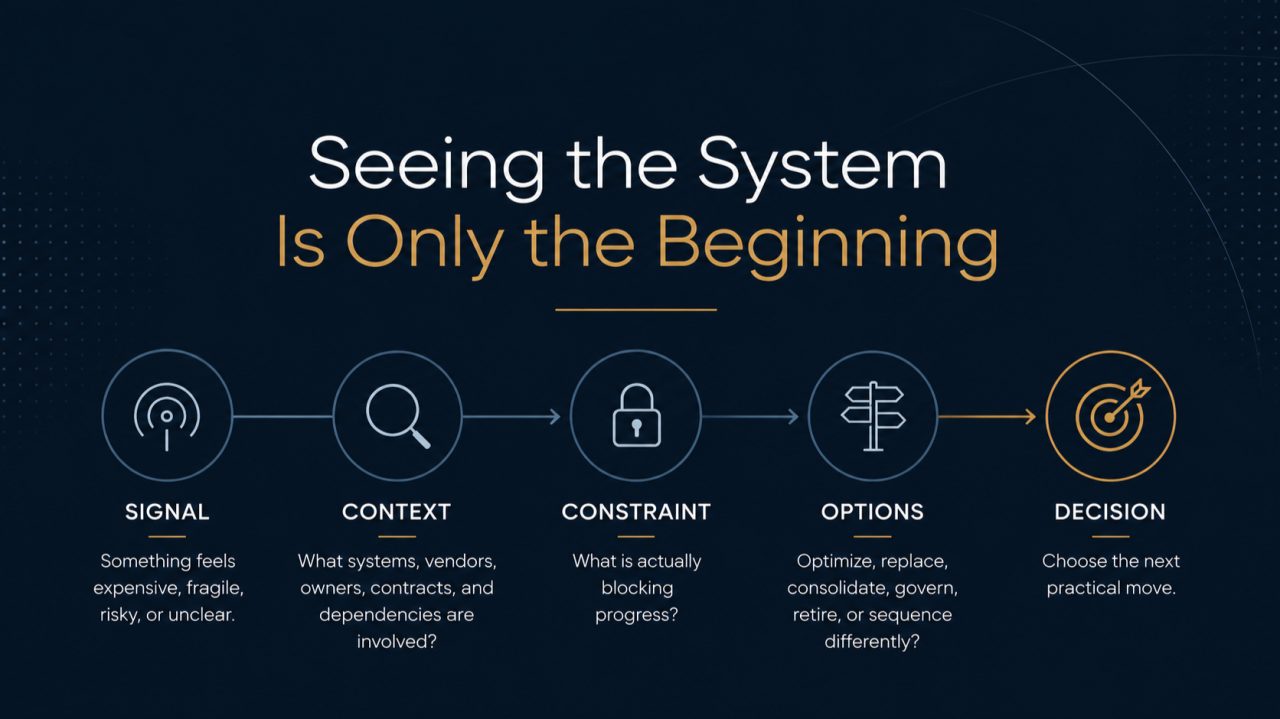
A business brings you an issue it can see. The next step is to understand what’s producing it, what depends on it, and who needs to be involved in resolving it.
Take a website that doesn’t clearly explain what the company does. Rewriting the copy might help. But first, someone needs to understand whether the business itself agrees on who it serves, what it offers, and why a customer would choose it.
Otherwise, the writer is being asked to resolve a positioning problem with better sentences.
Or consider a company that gets traffic but very few inquiries. The issue could be the offer, the contact process, or a page that doesn’t give visitors enough confidence to take the next step. It could also be that inquiries are arriving, but nobody’s tracking what happens to them.
You have to follow the path far enough to find out.
Email deliverability is another example. A message that never reaches its recipient can look like an outreach problem, even when the cause sits in domain configuration or technical ownership.
The same approach applies when the starting point is a platform renewal, an unreliable service, or an AI initiative. Before recommending a change, you need to understand the environment and the outcome the business needs.
Sometimes the fix is straightforward. Other times, the investigation exposes dependencies, overlapping tools, or gaps in responsibility that need attention first.
The visible issue gives you a starting point. The investigation gives you a basis for a decision.
That doesn’t mean every neglected website points to a troubled business. Sometimes the explanation is simply limited time or competing priorities. The value is in asking the questions and checking the answers.
The Conversation Starts Before You’re There
There’s another reason to pay attention to that outside view.
A prospective customer can research your company, look at your team on LinkedIn, read reviews, and compare alternatives before anyone in your organization knows they’re interested. They can also ask an AI tool to explain what you do or help them evaluate providers.
By the time they contact you, they may already have an impression of your expertise, credibility, and fit.
Your digital presence is helping shape that impression. The question is whether it gives people an accurate understanding of the business you’re running today.
That can be harder to judge from the inside than it sounds. You know what your services mean. You know which information is outdated. You know who to call when something doesn’t work.
A visitor doesn’t have that context.
So it’s useful to walk through the experience as someone who’s never dealt with your company before:
- Can they understand what you do and who you help?
- Does what they find across your website, search results, and LinkedIn tell a consistent story?
- Is the next step clear and easy to take?
- Who owns what happens after they take it?
- What evidence tells you the process is working?
Following one inquiry from discovery through response can reveal a lot about how messaging, technology, and responsibility connect.
It also makes the business implications tangible. A confusing page, a failed submission, or an inquiry that sits unanswered affects a real opportunity.
Where The Deady Group Fits
This is why digital presence and go-to-market fit naturally alongside The Deady Group’s technology advisory work.
The starting point may be different, but the questions are familiar. What’s the business trying to accomplish? What’s getting in the way? Which decisions need to happen first? And who will own the outcome once the work is done?
A website rebuild, a campaign, or a new platform may be part of the answer. Understanding the problem gives those investments a purpose and a way to judge whether they worked.
My role is to help make that connection: assess the situation, establish priorities, coordinate the right expertise, and keep the work tied to the business outcome.
That also means knowing when to bring in specialists. Technical implementation, security, design, content, and marketing each require their own expertise. The advisory work helps ensure those contributions support a shared objective and that responsibility stays clear across the handoffs.
RevereBeach.com has been a local, tangible example of that approach. It’s brought technology, reputation, business discovery, and community opportunity into the same conversation.
It’s also given me plenty to write about.
A Wider View of the Same Systems
Signals & Systems will continue exploring technology and the decisions around it, with more attention to how those decisions affect revenue, customer experience, reputation, and the communities businesses serve.
That builds on the questions this newsletter has explored from the beginning: what are the signals telling us, how do the systems connect, and what should we do with that understanding?
The RevereBeach.com work reinforced how useful the outside view can be. The experience someone has at the front door can help you identify which internal questions are worth asking.
So take a look at your business the way someone encountering it for the first time would. Follow the path they’d take, see where it gets confusing, and ask who owns what happens next.
The front door won’t tell you everything.
But it can tell you where to start looking.
This issue also ran on LinkedIn, where you can follow Signals & Systems.