Artificial intelligence is entering organizations faster than governance structures were designed to handle it.
Not through major deployments or formal initiatives, but through dozens of small capabilities embedded across the software stack.
Instead, it enters quietly through copilots embedded in SaaS tools, automation features inside collaboration platforms, analytics assistants in CRM systems, and the generative AI tools employees experiment with on their own.
Each introduction seems small. However, when they accumulate across the environment, they create a governance challenge most organizations weren’t designed to manage.
That challenge now has a name.
Shadow AI.
And the signal is already emerging.
Gartner predicts that by 2030, 40 percent of enterprises will experience an AI-related security or compliance breach linked to shadow AI.
That forecast is less about model safety and more about visibility and governance readiness. In other words, the real challenge is operational AI governance.
AI capabilities are entering organizations faster than the systems designed to manage them.
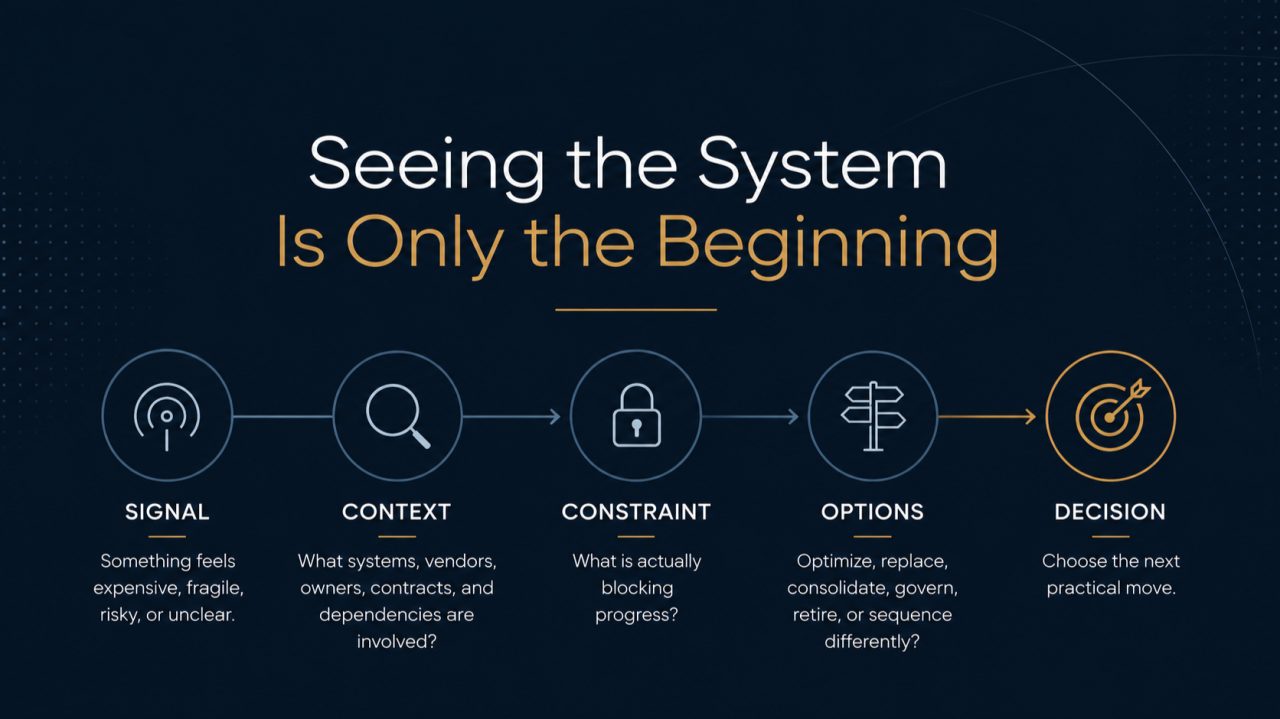
The Signal
Most IT leaders don’t have a clear inventory of where AI is operating across their environment.
That doesn’t mean they lack discipline or governance frameworks. It means the technology landscape has changed faster than the operating model that governs it.
AI capabilities now appear inside tools that were originally purchased for entirely different reasons. Collaboration platforms summarize conversations. CRM systems generate forecasts. Security platforms recommend remediation steps. Analytics tools suggest actions automatically.
From the user’s perspective, these features simply make the product better.
From a governance perspective, however, they introduce new decision layers that interact with data, workflows, and identity systems.
This is where AI governance shifts from policy discussion to operational design.
When those interactions are invisible, risk accumulates quietly.
Why AI Governance Is Harder for the Mid-Market
Large enterprises usually have formal governance teams and dedicated AI programs. Mid-market organizations often don’t have that luxury.
Instead, they operate with smaller teams that carry multiple responsibilities across infrastructure, security, and applications.
That doesn’t mean the risk is smaller. In many cases it’s the opposite.
Mid-market environments often adopt cloud platforms and SaaS tools quickly because they need efficiency and flexibility. However, those same tools increasingly include AI features that activate automatically or require only a simple toggle to enable.
Without clear visibility into where those features live and how they interact with internal systems, AI can begin influencing workflows before governance even enters the conversation.
That’s where readiness matters more than scale.
What Shadow AI Actually Looks Like
Shadow AI doesn’t always appear as employees secretly using ChatGPT at work.
More often, it appears in subtle ways across everyday systems.
- A sales platform begins generating automated forecasts based on internal data.
- A support system drafts responses using AI trained on historical tickets.
- A collaboration platform summarizes internal conversations and shares insights automatically.
- A security tool recommends remediation actions based on behavioral patterns.
None of these features are inherently risky. In fact, many are valuable.
However, they introduce new decision inputs that interact with existing processes. If the organization doesn’t understand how those inputs are produced, governed, and monitored, small assumptions can compound into larger operational risk.
This is why shadow AI is less about rogue behavior and more about structural visibility.
The Readiness Gaps That Create Shadow AI Risk
Across organizations, the same governance gaps tend to appear once AI capabilities begin spreading through the environment.
- Visibility. Many teams don’t know which systems now include AI features or how those capabilities interact with internal data.
- Ownership. When AI generates an insight or recommendation, it’s often unclear who is accountable for validating that output before it influences a decision.
- Data exposure. AI systems rely on prompts and contextual data. If governance over those data flows is inconsistent, sensitive information can appear in places it was never intended to go.
- Identity and access alignment. AI systems interact with multiple systems simultaneously. When identity policies were designed primarily for human users, automated interactions can introduce unintended access paths.
- Workflow integration. AI recommendations frequently enter operational processes that were originally designed for manual judgment. Without clear exception handling, teams may either ignore AI outputs or rely on them without proper validation.
- Observability. Many organizations lack clear monitoring for how AI is influencing decisions across their environment. Without visibility, leaders can’t easily assess performance, bias, or operational impact.
None of these gaps appear dramatic in isolation. However, together they create the conditions where AI spreads faster than governance can keep up.
A Practical Readiness Lens
Organizations don’t need to eliminate shadow AI entirely. That would slow innovation and prevent teams from benefiting from useful capabilities.
However, they do need a way to evaluate readiness before AI expands further.
Before expanding any AI capability, leaders should pause long enough to ask a few structural questions about readiness.
- Do we know which systems now include AI features or embedded models?
- Do we understand which data those systems access and how it is governed?
- Is there a clearly defined owner responsible for validating AI-generated insights?
- Can we observe how AI outputs influence decisions across workflows?
- If an AI-generated action causes an operational issue, do we know who is responsible for escalation?
If those answers are unclear, the issue isn’t the AI itself. It’s the system surrounding it.
Closing Perspective
Artificial intelligence is becoming a normal feature of modern software. That trend will accelerate, and in many cases it will deliver real productivity gains.
However, intelligence at scale requires more than capable models. It requires visibility, ownership, and governance that match how work actually happens across systems.
Shadow AI is simply the signal that those foundations are still catching up.
Organizations that invest in readiness now will find that AI becomes a powerful operational advantage. Those that ignore the governance layer may discover that the real challenge isn’t deploying AI at all.
It’s understanding where AI already lives across the organization.
What I would pay attention to next: Where AI capabilities are quietly appearing inside existing platforms. Many organizations are focusing on new AI initiatives while overlooking the intelligence already embedded across their current software stack.
For more field perspectives on resilience, operational clarity, and systems thinking, see Insights.
This issue also ran on LinkedIn, where you can follow Signals & Systems.