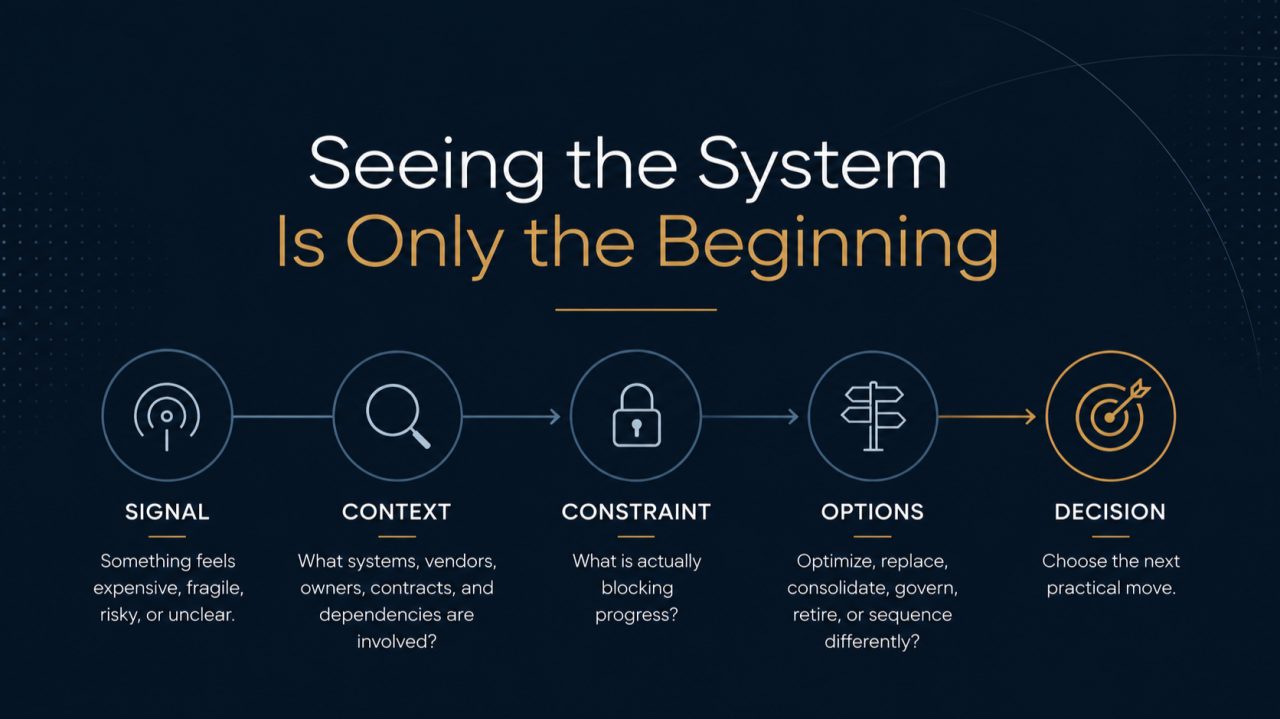
How do you choose an IT consulting firm in Boston? Decide first whether you need someone to run your technology or someone to help you make a decision, because those are different firms. Then shortlist three that have worked with companies of your size and industry, ask each how they are paid, and judge them on what they ask you, not on what they present. The right firm raises Massachusetts requirements you did not mention and tells you what it would not change.
Greater Boston has a deep bench of IT firms: national consultancies, regional managed service providers, specialists in healthcare, life sciences, finance, and higher education, and independent advisors. The range is a strength. It also makes it easy to hire a capable firm that is wrong for the job.
Start with what you actually need
Most buyers say "IT consulting" when they mean one of three things.
- Someone to run IT day to day. Help desk, devices, backups, patching, monitoring. That is a managed service provider, paid monthly.
- Leadership and direction. A roadmap, a budget, vendor management, and someone accountable to the owner or board. That is a fractional CIO or an internal hire. We explain the role in what a fractional CIO does.
- A decision made well. Choosing a provider, renegotiating contracts, preparing for a cyber insurance renewal, replacing a phone system, or deciding what to modernize first. That is an independent technology advisor, engaged for a defined piece of work.
Many Boston firms offer all three. That is not a problem in itself, but it changes how you read their advice. A firm that sells managed services will tend to recommend managed services.
Massachusetts requirements a good firm raises unprompted
A firm that works with Massachusetts companies should bring these up early, without being asked.
- 201 CMR 17.00. Massachusetts requires any business that owns or licenses personal information about Massachusetts residents to maintain a written information security program with administrative, technical, and physical safeguards (Mass.gov). If a firm does not ask whether you have one, that tells you something.
- Breach notification. Massachusetts law sets specific notification duties after a breach of personal information. A good firm will ask who in your company owns that response.
- Cyber insurance. Carriers now ask detailed control questions at renewal. We cover what Massachusetts organizations are seeing in navigating Massachusetts cyber insurance.
- Industry rules. Healthcare, financial services, education, and state and local government each carry their own requirements. Experience in your industry is not optional.
Seven questions that separate firms
Ask every firm on your shortlist the same questions, in writing if you can.
- How are you paid, and by whom? Monthly fees, project fees, and commissions or referral fees from vendors they recommend are all legitimate. Undisclosed ones are not. Ask before they recommend anything.
- Which companies like ours have you worked with in the last two years? Size and industry matter more than logos.
- What would you need to see before recommending anything? Good firms ask for an inventory, contracts, and current pain points. Firms that recommend a solution in the first meeting are selling it.
- What would you leave as it is? A firm that wants to replace everything has not looked closely.
- Who will do the work? The person in the sales meeting is not always the person on the account.
- How do you hand off or exit? Ask how documentation, credentials, and knowledge come back to you if the relationship ends.
- What does the first ninety days produce? Expect specifics: an assessment, a roadmap, a risk list, a renewal calendar.
Red flags
- A proposal arrives before anyone has asked about your contracts or current providers.
- The firm will not say how it is paid on products it recommends.
- Every recommendation is a product the firm sells.
- No mention of security, insurance, or Massachusetts requirements.
- Long-term contracts with auto-renewal and no clear exit terms.
Compare them on one page
Put the shortlisted firms on one scoring sheet with weighted criteria: fit to your actual requirement, total cost over the term, risk, contract terms, and references from companies like yours that you chose, not the firm. Include your current provider and the option of changing nothing. Our IT vendor evaluation template is built for exactly this.
Where The Deady Group fits
We are an independent technology and growth advisory based in Boston, at 867 Boylston Street. We do not run help desks or resell managed services. We help organizations make the decision well, including choosing an IT firm, and we disclose how we are paid before any recommendation, under our Transparency Standard. If you want an outside view of your environment before you talk to any firm, the Digital Presence & Technology Review is a good place to start.
Questions, answered plainly
What is the difference between an IT consultant and a managed service provider? A managed service provider runs your IT day to day for a monthly fee. An IT consultant or advisor is engaged for decisions and projects: strategy, provider selection, security programs, or a specific migration. Many firms do both, which is worth knowing, because the firm advising you may also be selling you the service.
Do we need a Boston-based firm? Not always, but local presence helps for on-site work, Massachusetts-specific compliance, and relationships with local carriers and data centers. For pure advisory work, experience with companies like yours matters more than distance.
What does 201 CMR 17.00 require? It requires any business that owns or licenses personal information about Massachusetts residents to maintain a written information security program with administrative, technical, and physical safeguards. A competent IT consulting firm will ask whether you have one.